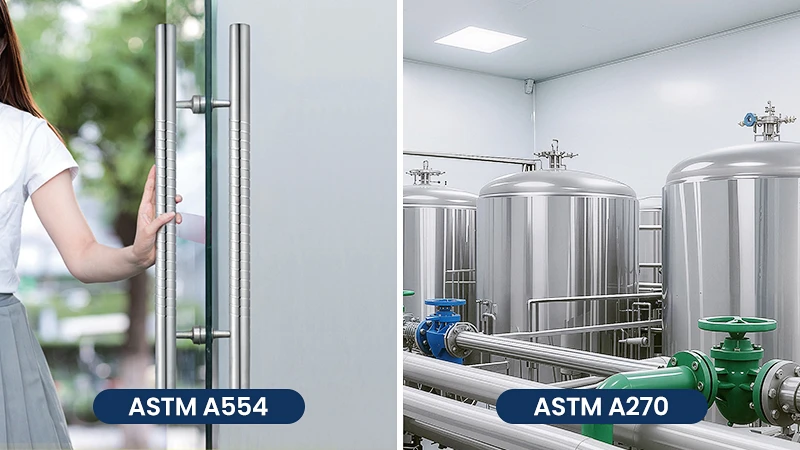
When you choose stainless steel tubes, you may come across words like ASTM, EN, DIN, or JIS. All of these are names for different standard systems for stainless steel. Then you have to add codes like A270 or A554, which makes it hard to know which standard is right for your project.
Why Are Stainless Steel Tube Standards So Confusing?
Why are there so many different categories? And why do they look so hard?
There is no one group that made all the standards for stainless steel tubes. Over time, different countries and industries built their own systems. ASTM is used in the United States. EN is used in Europe. Germany used to use DIN. Japan uses JIS. Every system has its own way of thinking and what it focuses on.
However, the confusion also comes from these differences:
1. Different naming and numbering systems
The same type of tube may have completely different names in different standards. This makes it hard to know if they are equivalent at first glance.
2. Different technical requirements
Even if two standards look similar, they may still be different in areas such as:
- Wall thickness tolerance
- Chemical composition limits
- Testing methods
These differences mean that standards that look the same aren’t always interchangeable.
Here is a simple comparison to help you understand these systems better:
| Standard System | Region / Country | Issuing Organization | Brief Description | Example |
| ASTM / ASME | United States | ASTM International / American Society of Mechanical Engineers (ASME) | Widely used in global industrial projects, especially for pressure and mechanical applications. | ASTM A554, ASTM A270 |
| EN (DIN) | Europe (Germany origin) | European Committee for Standardization (CEN) | Unified European standards; former DIN standards have largely been harmonized into EN. | EN 10216-5, EN 10217-7 |
| JIS | Japan | Japanese Industrial Standards Committee (JISC) | Commonly used in Japan and parts of Asia, known for detailed technical specifications. | JIS G3446, JIS G3459 |
| GB / GB/T | China | Standardization Administration of China (SAC) | National standards used in China; GB indicates mandatory standards, GB/T indicates recommended standards. | GB/T 14976, GB/T 13296 |
| ISO | International | International Organization for Standardization (ISO) | Provides international guidelines, often used for dimensional tolerances and general requirements. | ISO 1127 |
Many standards can be compared to each other, but “equivalent” does not mean “the same.” Before making any changes, always check the technical details.
Which Stainless Steel Tube Standard Should You Choose for Your Application?
ASTM is one of the most widely used stainless steel tube standard systems in global projects. Under the ASTM system, the most common standards for stainless steel tubes include:
- ASTM A554
- ASTM A270
- ASTM A312
- ASTM A249
Of course, these are only the most common ones in the industry. The ASTM system covers many more stainless steel tube standards. If you want to see a full list, you can refer to ASTM Volume.
Next, we will explain these standards one by one based on real application scenarios. This will help you find the right standard for your needs.
Structural & Decorative Applications
If your project requires handrails, railings, curtain wall tubes or other mechanical structures, then ASTM A554 is generally the appropriate standard. A554 is for welded stainless steel tubes. It focuses on surface quality and size accuracy, not on performance under high pressure or high temperature. So, it is widely used in decorative and structural applications.
For international reference, A554 can be compared with the following standards:
| Standard | Organization | Description |
| ASTM A554 | ASTM (USA) | Welded stainless steel tubes for mechanical and decorative use |
| JIS G3446 | JIS (Japan) | Stainless steel tubes for mechanical structures |
| GB/T 12770 | China | Welded stainless steel tubes for mechanical structures |
| DIN 17455 | DIN (Germany) | Welded stainless steel tubes (now replaced by EN standards) |
| EN 10296-2 | EN (Europe) | Welded stainless steel tubes for mechanical and general engineering use |
If your project needs specific sizes or cross-standard requirements, you can check our A554 product page for more details.
Food & Hygienic Industry
The food, beverage, and pharmaceutical industries have really different requirements for tubes. In these settings, pressure resistance is not the top priority. What matters most is the cleanliness of the inner wall and the surface finish.
ASTM A270 was developed specifically for this type of sanitary application. It sets clear requirements for inner surface roughness (Ra value). This helps prevent contamination buildup inside the tube, meeting food safety and GMP standards.
If your project needs to comply with 3-A Sanitary Standards or FDA regulations, A270 is the baseline standard to follow when selecting tubes.
For equivalent international standards, see the reference table below:
| Standard | Issuing Body | Description |
| ASTM A270 | ASTM (USA) | Sanitary stainless steel seamless and welded tubes |
| EN 10357 | EN (Europe) | Stainless steel tubes for food, chemical, and pharmaceutical industries |
| DIN 11850 | DIN (Germany) | Stainless steel tubes for the food industry (widely used in European markets) |
To learn about the A270 sanitary tube specifications and surface finish options we offer, visit our product page or contact us directly.
Industrial & Pressure Piping
In chemical and petrochemical industries, pipes often need to handle pressurized and corrosive media. For these applications, ASTM A312 is one of the core standards used in industrial piping systems.
ASTM A312 covers both seamless and welded stainless steel pipes. It is widely used in pressure piping applications.
In other standard systems, there is no direct one-to-one equivalent. However, some standards are used in similar applications. For example, EN 10217-7 covers welded stainless steel pipes for pressure purposes, while JIS G3459 applies to stainless steel pipes used in high-temperature and pressure service.
Heat Exchanger & Mechanical Tubing
In heat exchangers, condensers, and similar equipment, stainless steel tubes must stay stable through repeated thermal expansion and contraction cycles. Good corrosion resistance is also required.
ASTM A249 is widely used for welded stainless steel tubes in heat exchangers, condensers, and boilers.
In other standard systems, there is no direct one-to-one equivalent to A249. However, some standards are used in similar applications. For example, EN 10217-7 is used for pressure-purpose welded tubes, while JIS G3463 is closer to A249 in boiler and heat exchanger applications.
Conclusion
Different applications call for different stainless steel tube standards. Choosing the right standard helps you avoid procurement risks. It also leads to better decisions on cost and lead time.
If your project involves structural, decorative, or food-grade sanitary applications, feel free to reach out to E-stainless. We specialize in the production and supply of ASTM A554 and A270 stainless steel tubes. We can also help you match cross-standard requirements and find the right solution for your project.