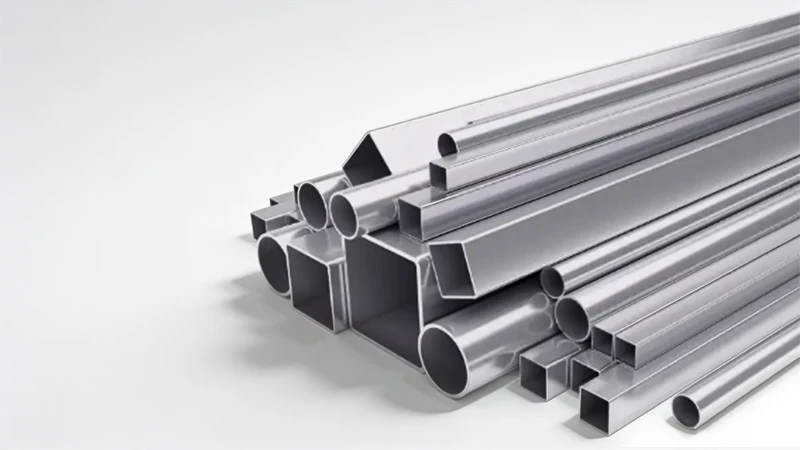
Stainless steel tubes are used across many industries, including architectural decoration, food machinery, and sanitary piping. However, choosing the right size is not always straightforward.
In this guide, we start with the basic difference between tube and pipe. We then cover the key size parameters and common dimensions under ASTM A554 and ASTM A270. By the end, selecting the right stainless steel tube size should feel much more manageable.
Stainless Steel Tube vs Pipe: Why the Sizes Are Different
We often hear customers say, “I need a stainless steel pipe.” But when we discuss the details, they actually need a tube with a 35mm outside diameter for a precision application. This is one of the most common misunderstandings we come across. It comes down to a real difference between tube and pipe.
The key difference is not the shape. It is how the sizes are defined and what each product is used for.
Stainless steel pipe is designed to carry fluids such as water, gas, and oil. Its dimensions are defined by NPS (Nominal Pipe Size) and Schedule number. Buyers focus mainly on whether the inside diameter can handle the required flow rate and whether the wall can withstand the pressure. The exact outside diameter is less of a priority.
Stainless steel tube is used for structural support, decorative purposes, or precision applications. Common examples include architectural handrails and sanitary lines in food processing equipment. Because of these use cases, tube dimensions are defined by the actual outside diameter (OD) and wall thickness (WT). Dimensional accuracy and consistency are the main concerns.
Once you are clear on whether you need tube or pipe, the rest of the sizing process becomes much easier.
Key Parameters for Understanding Stainless Steel Tube Sizes
We’ve already mentioned that Tube dimensions are defined using OD and WT. Now, let’s briefly look at some of the other core parameters for stainless steel pipe dimensions.
1. Outside Diameter (OD)
This is the first and most important measurement to confirm. The OD determines whether the tube will fit your installation correctly.
2. Wall Thickness (WT)
Wall thickness affects two things. First, it determines the strength of the tube, including its ability to bear loads and resist deformation. Second, it affects the cost. Thicker walls require more material, so the price goes up accordingly.
3. Length
Length may seem simple, but it is worth paying attention to. Fixed lengths such as 6m are ready to use without further processing. Random lengths cost less but require additional cutting before use. If your project has strict installation requirements, please let the E-Stainless team know in advance. We offer custom cutting to match your exact specifications.
4. Tolerance
Tolerance refers to the acceptable range of variation between the stated size and the actual manufactured size. Different standards allow different levels of variation. ASTM A270, for example, is used for sanitary tubing. It has tighter tolerance requirements because dimensional consistency is critical in those applications.
These parameters are crucial in the selection process. Mastering these fundamentals will make your purchasing decisions more efficient and smooth. For custom processing needs, please feel free to contact the E-Stainless team; we will provide you with professional technical support.
ASTM A554 Stainless Steel Tube Sizes
If your project involves structural or decorative applications such as railings, handrails, or frames, ASTM A554 is most likely the standard you will be working with.
A554 tubes are available in a variety of shapes. The most common are round, square, and rectangular tubes. Special shapes such as channel tubes and oval tubes are also available. Material grades include 200, 304, 304L, 316L, and 400. Below, we cover each shape and its typical size range.
Round Tubes
Round tube is the most widely used type. At E-Stainless, our round tubes are available in outside diameters from 9.5mm to 215mm, with wall thicknesses from 0.4mm to 5.0mm. This range covers most needs, from lightweight decorative pieces to mid-strength structural applications. Whether you are building railings, furniture, or basic mechanical components, there is a size that fits.
Round tube handles stress evenly from all directions, which makes it more stable in structural use. Therefore, they are less prone to localized deformation or insufficient strength caused by uneven stress distribution during use. Grades like 304 and 316L offer solid corrosion resistance for both indoor and outdoor environments. This combination of strength and clean appearance makes round tube a natural fit for railings and handrails.

Square Tubes
Square tube works well when a project involves frame structures or multiple connection points. At E-Stainless, our square tubes under ASTM A554 range from 8×8mm to 120×120mm, with wall thicknesses from 0.4mm to 3.0mm.
Square tube has clean, well-defined edges. This makes it easy to position and align during installation. It also connects to other components more securely, which is why it is widely used in frame structures across many types of projects.
In these applications, square tube often requires secondary processing such as bending, cutting, or welding. At this stage, weld seam quality becomes a critical factor.
A poorly treated weld seam can crack or split during bending or further processing. This affects the quality of the finished product and raises safety concerns.
To prevent this, we pay close attention to weld seam treatment during production. Our tubes are manufactured to ensure the seam does not crack or split under secondary processing. The surface is also free of visible gaps, keeping the overall structure reliable and safe to use.
Rectangular Tubes
Our rectangular tubes range from 9.6×19mm to 60×120mm, with wall thicknesses from 0.4mm to 3.0mm. They are commonly used in structural and support applications such as machinery frames and construction components.
All E-Stainless tubes are available in a range of surface finishes, from matte to mirror polish. Options include BA, HL, and 8K, etc. Please let us know what your project requires, and we can arrange the right finish for you.

Special-Shaped Tubes
Some projects require something beyond standard shapes. Special-shaped stainless steel tubes include oval tubes and slot tubes. Each is designed to meet specific functional or aesthetic requirements.
Oval tubes are popular in decorative settings such as railings, furniture, and commercial interiors. Slot tubes are more functional. They are often used in glass railings and recessed structures. Using channel tubes can reduce the number of processing steps and speed up installation.
These products do not follow a fixed size chart the way standard tubes do. Dimensions are typically selected or customized based on the specific project. We have included a size reference diagram below to help you compare common special-shaped tube options.

ASTM A270 Stainless Steel Tube Sizes
The ASTM A554 tubes covered above are mainly for structural and decorative use. In industries like food, beverage, and pharmaceutical manufacturing, the hygiene requirements are much stricter. The applicable standards and size specifications are also different.
In food, beverage, and pharmaceutical applications, stainless steel tubes are used to carry liquids such as water, dairy products, and medications. Round tube is the standard choice in these settings. Fluid flows more smoothly through a circular cross-section. There are also fewer spots where residue can collect, which makes cleaning and maintenance easier. For these reasons, ASTM A270 stainless steel round tubes are widely used in sanitary applications.
Our A270 tubes are available in outside diameters from 15.9mm to 406.4mm, with wall thicknesses from 0.9mm to 5.0mm. This range covers both small-bore precision lines and large-volume flow systems.
We source our raw material directly from three of China’s leading steel mills: TISCO, Baosteel, and Tsingshan. Every batch is traceable by heat number and production lot.
During production, we polish both the inside and outside surfaces of the tube. The inner surface roughness is consistently controlled at Ra ≤ 0.4μm. This smooth finish reduces product buildup, lowers the risk of contamination, and makes the tube easier to clean. It meets the practical demands of sanitary processing environments.
Conclusion
Choosing the right stainless steel tube does not have to be difficult. Start by confirming whether you need tube or pipe. The two products are sized differently and are used for different purposes. Next, identify the four key parameters: OD, WT, length, and tolerance. Getting these right will help you communicate your requirements clearly and avoid unnecessary mistakes.
If you are currently selecting a tube or have questions about specific sizes, please get in touch with the E-Stainless team. We can help you find the right specification and support any custom processing requirements.