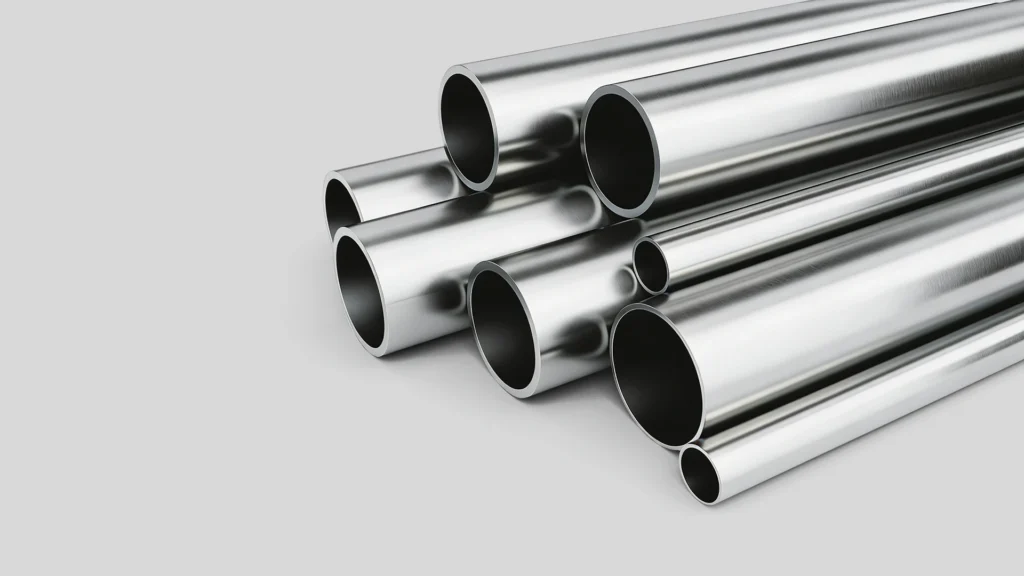
The same problem which many buyers have come across in sourcing 304 stainless steel tube. The stuff begins to rust after a time, or else it just does not hold up as well as it should. For the most part, the problem is not with 304 itself. The problem is that 304 wasn’t actually what you got.
In this article we discuss 3 things: what is 304 stainless steel tube, how does compare to 201 and 316, and how you can ensure the material you receive is genuine?
What Is 304 Stainless Steel Tube?
304 stainless steel tube is one of the most widely used metal tubes in industrial and commercial settings. To understand why it’s so trusted, it helps to start with what it’s actually made of.
Chemical Composition & Key Properties
304 stainless steel is built around two main elements: chromium (Cr) and nickel (Ni). It contains around 18% chromium and 8% nickel. This combination creates a stable oxide layer on the surface, which is what gives 304 its strong corrosion resistance.
Beyond corrosion resistance, 304 is also easy to work with. It welds, bends, and cuts without much trouble. In its annealed state, it is non-magnetic. It also holds up well across a wide temperature range, which makes it suitable for most industrial applications.
Typical Applications Across Industries
These properties make 304 a go-to material across many industries. It is commonly used in food and beverage processing equipment, pharmaceutical production lines, architectural structures, and chemical fluid transport systems. These applications all demand materials that are hygienic, durable, and cost-effective. 304 material strikes a good balance between performance and cost.
304 vs 316 vs 201 Stainless Steel Tube: Which One Do You Need?
After discussing the basic characteristics of 304, many people will naturally have the next question: There are also models like 201 and 316 on the market. What are the differences between them and 304, and which one should I choose for my project?
201 costs less than 304 and looks almost identical on the surface. That’s exactly why it gets passed off as 304 so often. But the two are quite different in composition. 201 replaces part of the nickel with manganese, which makes it noticeably less corrosion-resistant. In humid or mildly corrosive environments, 201 is more likely to rust. If corrosion resistance matters for your application, 201 is not a reliable substitute.
316 takes 304 a step further by adding molybdenum (Mo) at around 2–3%. This makes 316 significantly better at resisting chlorides, salt spray, and acidic media. If your tubes will be used in coastal environments, exposed to seawater, or involved in chemical fluid transport, 316 is the safer choice. However, if the application scenario is indoor structural components, food processing equipment, or general fluid transportation, 304 can fully meet the requirements, and the cost is lower than 316.
Choosing between 304, 316, and 201 comes down to environment and budget. 201 trades corrosion resistance for a lower price. 316 trades a higher price for stronger corrosion resistance. 304 strikes a balance between the two, offering wide applicability and high cost-effectiveness. That’s why it has become the mainstream choice in the market.
How to Verify the Material Quality of 304 Stainless Steel Tube
It’s a real issue that lower-grade stuff is getting sold as 304. At E-Stainless, we keep things simple. Quality is the bedrock of every relationship we build, and the tubes we sell are the real 304 deal. We don’t take shortcuts when it comes to sourcing or making our products.
We get all our raw materials straight from top-tier Chinese mills like TISCO, Baosteel, and Tsingshan. That means we’re starting with solid, reliable material every time. We provide a full Mill Test Report with every batch, so you can trace everything back to the specific heat number and production run to verify the composition.
Once the materials reach our shop, we run a spectral analysis on every single batch. This gives us a direct reading of the material’s elemental composition. We double-check those results against 304 standards before we even think about starting production.
Conclusion
Material authenticity is a central concern when sourcing 304 stainless steel tube. This article has touched on the key properties of 304, how it differs from 316 and 201, and how material quality can be verified from the source. We hope it serves as a useful reference as you work through your sourcing decisions.
At E-Stainless, we source raw materials directly from leading steel mills, provide traceable MTR reports, and conduct spectral testing upon arrival at the factory. This series of quality control measures is our basic commitment to every partner.